Maze
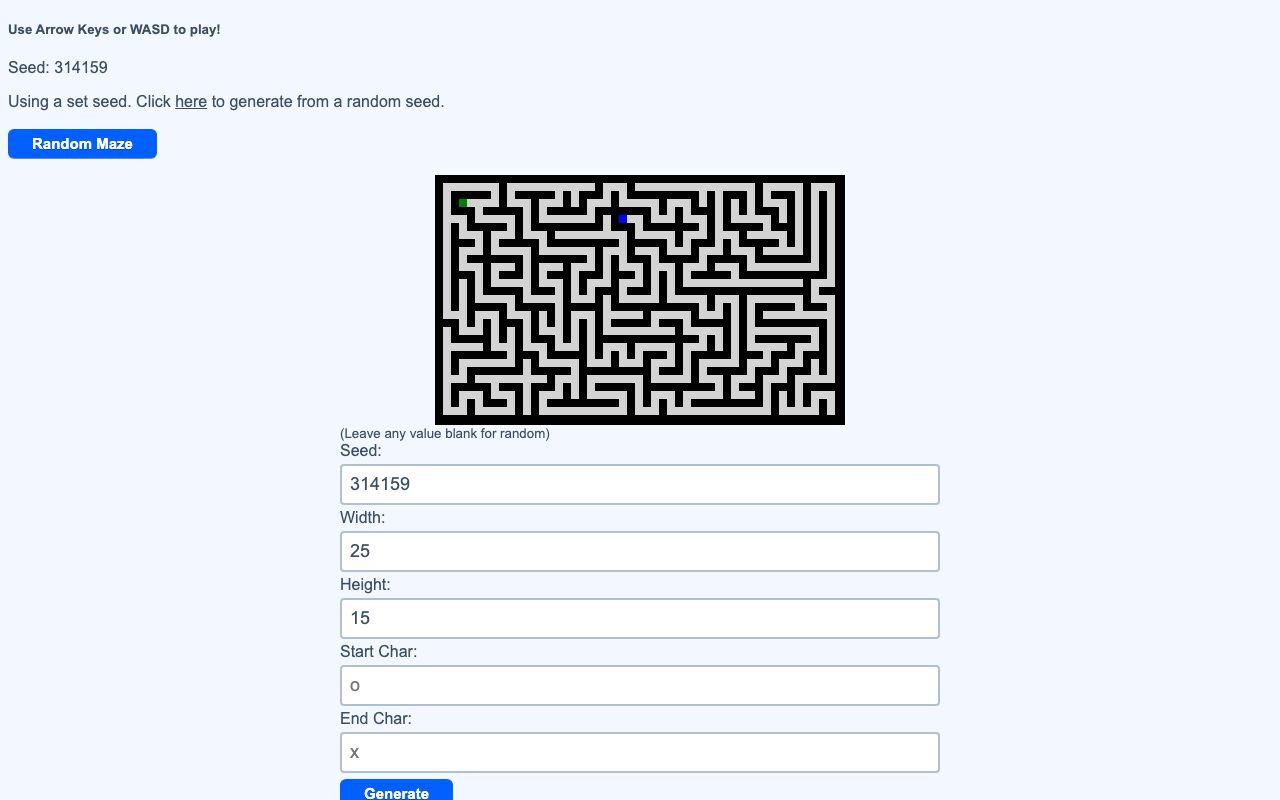
Maze generates a random maze from a numeric seed and shows it in the browser. The same seed always rebuilds the same maze, and the maze can also be requested as plain ASCII text or checked with a move string.
Maze solves the need for a repeatable maze that can be shared, replayed, or tested from a URL. It also provides a simple API for getting maze output and verifying whether a sequence of moves reaches the exit.
What it solves
Maze solves the need for a repeatable maze that can be shared, replayed, or tested from a URL. It also provides a simple API for getting maze output and verifying whether a sequence of moves reaches the exit.
The same maze can be shown as a browser game or fetched as text. A seed, size, and optional start and end characters control the output.
Features
- Seeded mazes Each maze is based on a numeric seed, so the same seed produces the same layout.
- Browser play The maze can be played with the arrow keys in the browser.
- Victory state Reaching the exit shows a victory message.
- Seed display Each page shows the current seed and provides a way to replay it or get a new random maze.
- Custom setup A form sets the seed, width, height, start character, and end character.
- Plain text output The maze can be returned as ASCII text for direct use in other tools.
- Size limits Maze dimensions are clamped to 3 to 50 cells per side.
- Solver endpoint A move string can be posted to test whether it solves the maze.
- Result feedback The solver returns the maze with the final position marked and uses status codes to show solved, incomplete, or invalid input.
- Open web calls The API supports browser requests with CORS and preflight handling.
How to use it
- Open the maze page to get a generated maze and its seed.
- Use the arrow keys to move through the maze in the browser.
- Use the form to change the seed, size, or start and end characters.
- Open the same maze again by using the same seed.
- Request the text version if plain ASCII output is needed.
- Post a move string to the solver endpoint to check a route through the maze.
How it works
- Deterministic generation It carves the maze by recursive backtracking over a grid of wall flags, and it seeds the random generator first so the result is reproducible.
- Exit placement The exit is placed on a random dead end found by scanning the rendered maze.
- Shared rendering The same maze rendering is used for the browser view, the text output, and solver checks.
- Server-side solving A move runner replays the submitted moves from the start cell and reports walls or invalid characters as errors.
- Client-side movement Browser play updates the maze state in the page DOM.