Little World
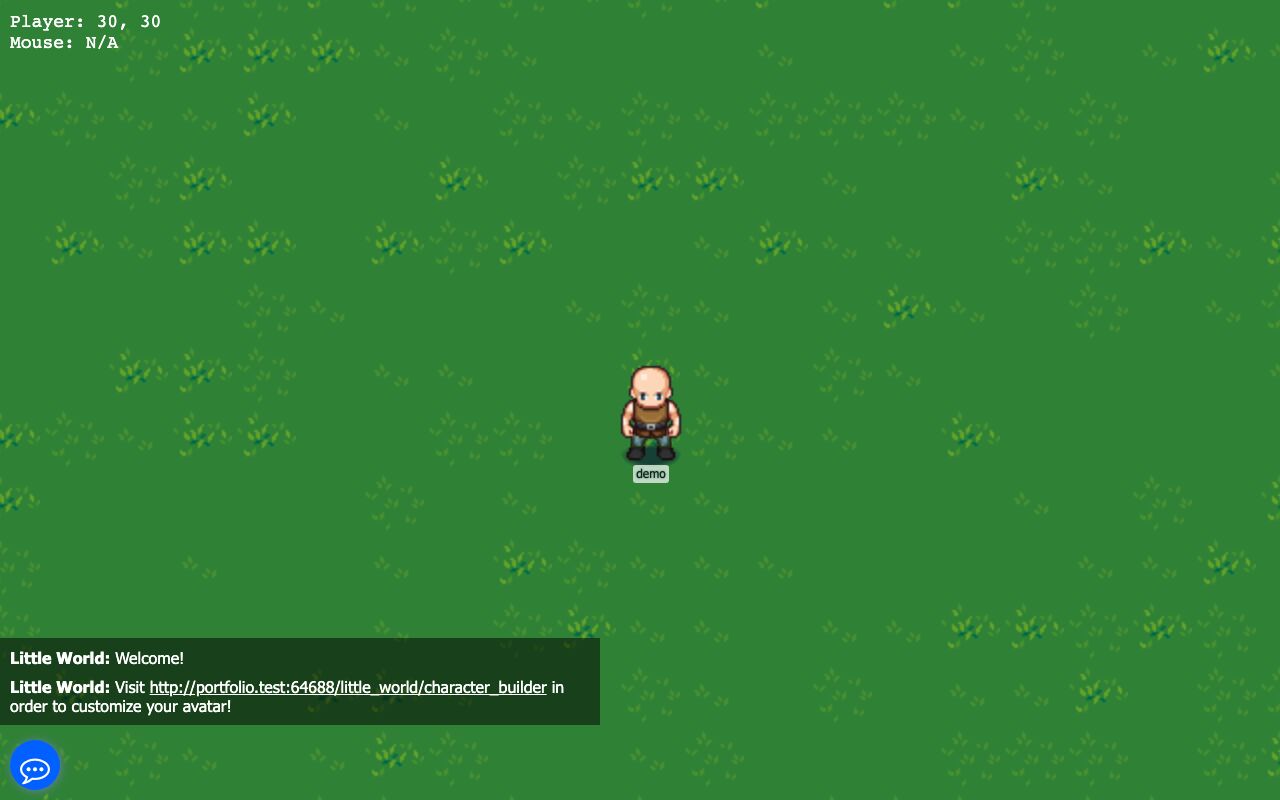
Little World is a small multiplayer browser world built from plain HTML divs. It shows a tile map, animated player characters, and chat bubbles above each player.
It gives visitors a shared space where they can walk around a map, see other connected players in real time, and chat. The page also keeps each avatar's position and appearance, so returning players continue from where they left off.
What it solves
It gives visitors a shared space where they can walk around a map, see other connected players in real time, and chat. The page also keeps each avatar's position and appearance, so returning players continue from where they left off.
It avoids a canvas or game engine and uses the DOM, server-rendered partials, and WebSockets instead. That makes the world render as standard page content while still supporting movement, presence, and chat.
Features
- Tile movement Click or tap a walkable tile and the character pathfinds there with a walking animation.
- Live players Other connected players appear, move, and disappear in real time.
- Chat bubbles Messages appear in a chat log and as fading speech bubbles above the speaker.
- Position memory The character's last location is saved and restored later.
- Character Builder look The avatar's appearance comes from the Character Builder.
- Debug overlay A coordinate overlay shows the player's tile and the mouse's tile.
- Keyboard shortcuts Space recenters the view on the character, and J jumps to the hovered tile.
- Welcome message First-time visitors see a message that links to the Character Builder.
- Touch support Tap-to-move works on touch devices, with pinch-zoom suppression on iOS.
How to use it
- Open Little World in a browser.
- Click or tap a walkable tile to move the character there.
- Press Enter or tap the chat button to send a message.
- Use Space to recenter the view on the character.
- Use J to jump to the tile under the pointer.
- Change the avatar in the Character Builder, then return to see the updated look.
How it works
- The map is generated from ASCII layer files and rendered as one div per cell.
- Non-zero collision cells become obstacles, and the remaining cells are marked walkable.
- Grass tiles are auto-tiled from neighboring cells, with a fixed random seed so the layout stays the same on every load.
- Movement uses A* pathfinding on a four-direction grid over the walkable DOM tiles.
- Multiplayer uses ActionCable to broadcast login, logout, chat, and movement updates, with server-rendered HTML for player and message inserts.