Colors
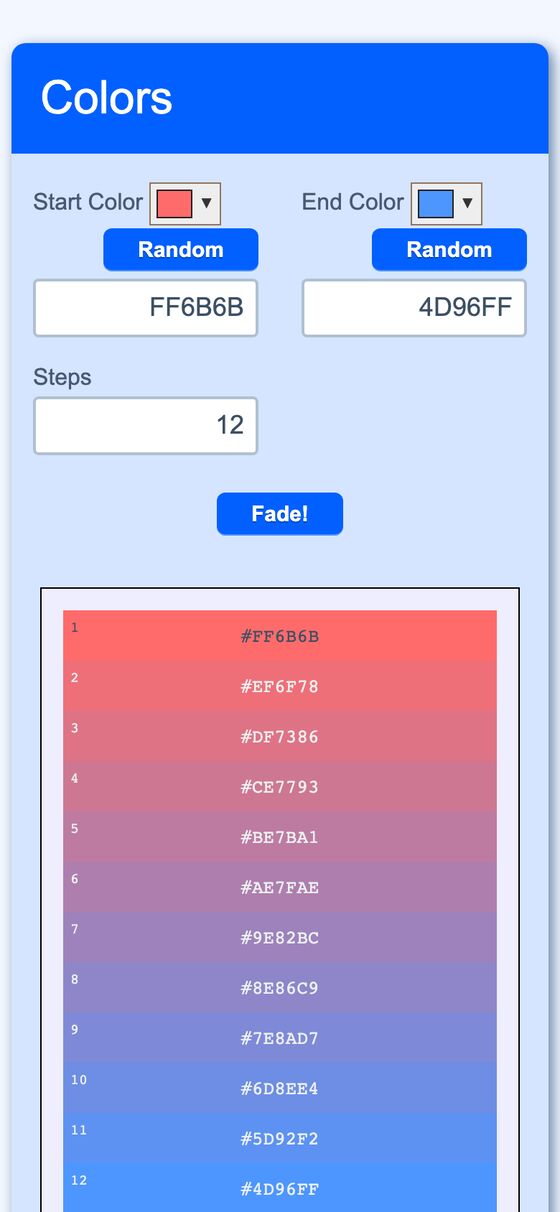
A color-gradient tool that generates evenly spaced colors between a chosen start and end color. It also serves the same output as a small public JSON API for palette requests.
It helps create a stepped color fade without calculating each intermediate color by hand. The tool returns the full sequence as labeled hex swatches and can also return the palette as JSON for scripts.
What it solves
It helps create a stepped color fade without calculating each intermediate color by hand. The tool returns the full sequence as labeled hex swatches and can also return the palette as JSON for scripts.
It supports server-side rendering, AJAX updates, and query-string URLs for sharing a specific palette. The API can also return a mirrored fade-back sequence for looping palettes.
Features
- Start and end colors: Pick the endpoints with color inputs and a visual color picker.
- Random color: Generate a random hex color and refresh the fade immediately.
- Step count: Choose how many colors to generate, with a default of 10 and a maximum of 256.
- Hex input support: Accept 3-digit or 6-digit hex values with or without the
#prefix. - Labeled swatches: Show each generated color as a numbered swatch with its hex value.
- Readable labels: Switch swatch text between dark and light based on background contrast.
- No page reload: Update the palette with AJAX and show validation messages inline.
- Shareable URLs: Load the same palette from query parameters in the browser.
- JSON output: Return the palette as a JSON array for script use.
- Fade-back option: Append the reverse palette in API responses for looping color sets.
How to use it
- Enter a start color.
- Enter an end color.
- Choose the number of steps.
- Use the random button if a color should be generated for either endpoint.
- Submit the form to generate the palette.
- Copy the URL or request the JSON endpoint if the palette needs to be reused elsewhere.
How it works
- It normalizes input hex values before generating colors.
- It interpolates colors in linear RGB space and clamps rounded values.
- It can append a mirrored fade-back sequence when requested through the API.
- It uses a luminance check to choose readable text color on each swatch.
- One controller action returns HTML, an XHR partial, or JSON depending on the request format.