Cards
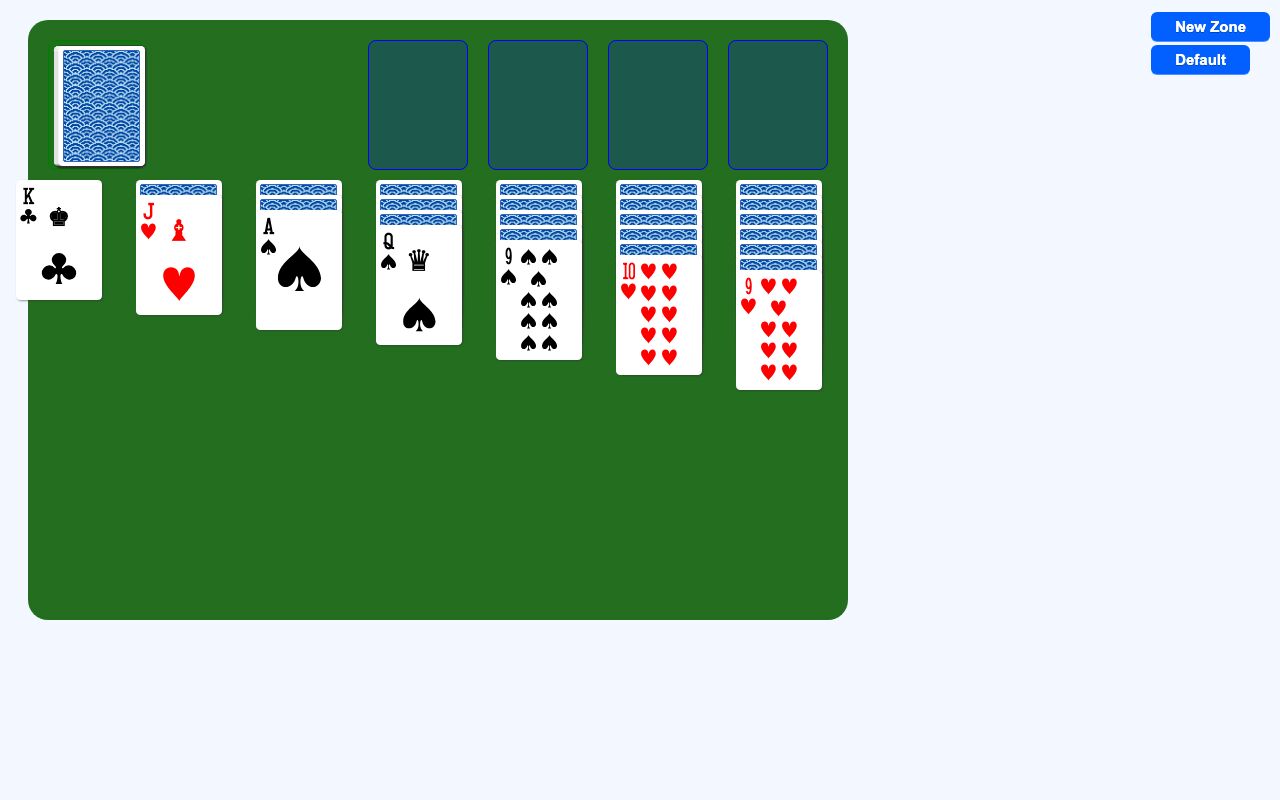
Cards is a browser-based virtual card table with a full 52-card deck. It lets cards be dealt, dragged, flipped, grouped, and arranged by hand on a green felt field.
Cards provides a way to play or prototype card layouts without a rules engine. It focuses on direct manipulation, so cards can be moved and organized freely instead of being constrained by game logic.
What it solves
Cards provides a way to play or prototype card layouts without a rules engine. It focuses on direct manipulation, so cards can be moved and organized freely instead of being constrained by game logic.
It also supports a standard Solitaire layout for Klondike-style play. The deck, zones, and card movements are handled in the browser after the initial page load.
Features
- Full deck A server-shuffled 52-card deck starts stacked in a Deck zone.
- Draw by drag Drag a card off the deck to draw it into play.
- Flip cards Click a card to turn it face up or face down.
- Keyboard dealing Press D to deal the top card to the cursor, and Shift+D to deal it face up.
- Selection tools Rubber-band select cards facing the same way, or use shift, control, or command clicks.
- Group moves Drag a selection and the cards keep their relative positions.
- Return to deck Drop cards back onto the deck to put them away.
- Zones New Zone creates a draggable, resizable colored rectangle for piles or player areas.
- Solitaire layout Solitaire deals a seven-column tableau with four foundation zones and an animation.
- Marker dot Press T to place a marker dot at the cursor.
How to use it
- Open the deck view.
- Draw cards by dragging from the Deck zone or by pressing D.
- Use Shift+D when a dealt card should start face up.
- Click cards to flip them, or select several cards with a drag or modifier-clicks.
- Drag a selected group to move the cards together.
- Add a zone if a pile or play area is needed, or use Solitaire for a Klondike layout.
How it works
- The deck is built in Ruby as 52 rank-and-suit codes and shuffled on the server.
- Each card is rendered as HTML, with face and back sides shown through CSS 3D transforms.
- Card faces are drawn with inline SVG suit icons, row-based pip layouts, and glyphs for face cards.
- Dragging, selection, hit-testing, and z-order updates are handled with jQuery UI and client-side JavaScript.
- Dealing animations run through a small callback queue, and zones are created at runtime as draggable, resizable regions.